About The Conformist
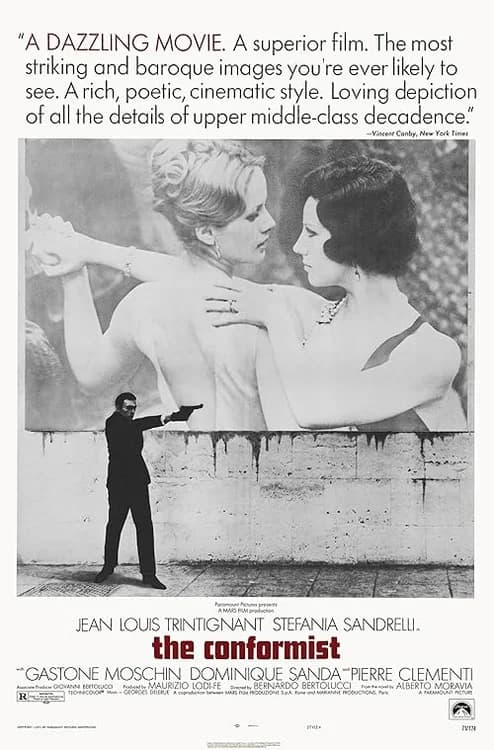
Bernardo Bertolucci's 'The Conformist' (1970) is a landmark of Italian cinema and a searing psychological portrait of moral compromise. The film follows Marcello Clerici, a man so desperate for normalcy in Mussolini's Italy that he agrees to become a fascist agent. His defining mission: travel to Paris to orchestrate the assassination of his former philosophy professor, now a political dissident. This is not a simple thriller, but a profound exploration of how personal trauma, sexual repression, and a craving for belonging can lead an individual to embrace a murderous ideology.
Jean-Louis Trintignant delivers a masterful performance as Marcello, capturing his profound emptiness and cowardice with chilling subtlety. The supporting cast, including Stefania Sandrelli and Dominique Sanda, is equally compelling. However, the film's true star is often its visual style. Cinematographer Vittorio Storaro creates a breathtaking tapestry of light, shadow, and geometric composition, using the film's stunning Art Deco and Fascist-era architecture to mirror Marcello's fractured psyche. Every frame is a painting, rich with symbolic meaning.
Viewers should watch 'The Conformist' not only for its historical and political insights but for its timeless examination of conformity and guilt. It remains one of the most visually influential films ever made, and its themes about the individual versus the state, and the cost of surrendering one's conscience, resonate powerfully today. It is a demanding, brilliant, and unforgettable cinematic experience.
Jean-Louis Trintignant delivers a masterful performance as Marcello, capturing his profound emptiness and cowardice with chilling subtlety. The supporting cast, including Stefania Sandrelli and Dominique Sanda, is equally compelling. However, the film's true star is often its visual style. Cinematographer Vittorio Storaro creates a breathtaking tapestry of light, shadow, and geometric composition, using the film's stunning Art Deco and Fascist-era architecture to mirror Marcello's fractured psyche. Every frame is a painting, rich with symbolic meaning.
Viewers should watch 'The Conformist' not only for its historical and political insights but for its timeless examination of conformity and guilt. It remains one of the most visually influential films ever made, and its themes about the individual versus the state, and the cost of surrendering one's conscience, resonate powerfully today. It is a demanding, brilliant, and unforgettable cinematic experience.