About The French Dispatch
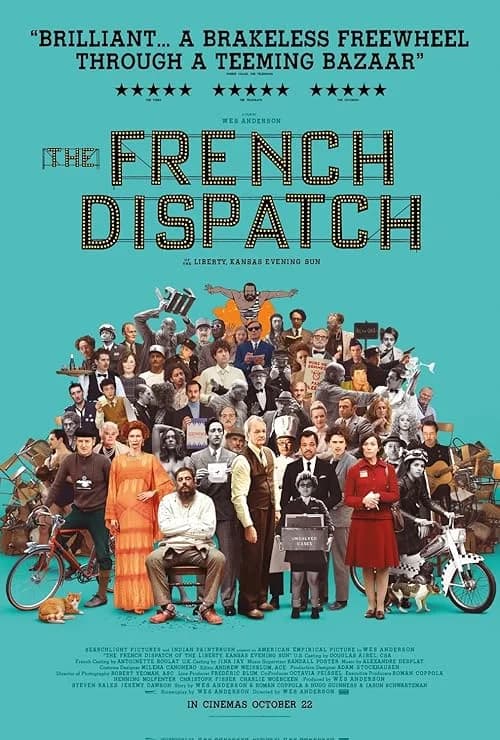
Wes Anderson's 2021 film 'The French Dispatch' is a visually stunning and narratively inventive anthology that serves as a love letter to journalism and storytelling. The film presents itself as the final issue of a fictional American magazine published in the French city of Ennui-sur-Blasé, bringing three distinct stories to life through the magazine's pages. Each segment features Anderson's signature symmetrical compositions, meticulous production design, and deadpan humor that has become his trademark.
The ensemble cast delivers exceptional performances across multiple storylines. From Timothée Chalamet as a revolutionary student leader to Frances McDormand as a journalist navigating ethical boundaries, each actor fully embodies Anderson's unique cinematic world. Bill Murray anchors the film as the magazine's editor, Arthur Howitzer Jr., whose dedication to his publication provides the emotional throughline connecting the disparate tales.
What makes 'The French Dispatch' particularly compelling is how it balances Anderson's distinctive aesthetic with genuine emotional depth. While the visual style is immediately recognizable—with its pastel color palettes, precise framing, and whimsical animation sequences—the film also explores themes of artistic passion, cultural displacement, and the power of storytelling. The anthology format allows Anderson to experiment with different tones, from political satire to romantic drama, while maintaining a cohesive vision.
Viewers should watch 'The French Dispatch' not just for its technical brilliance, but for its celebration of eccentricity and creativity. The film rewards multiple viewings, with each revealing new visual details and narrative connections. It stands as one of Anderson's most ambitious works—a cinematic magazine that honors both the written word and the art of filmmaking itself.
The ensemble cast delivers exceptional performances across multiple storylines. From Timothée Chalamet as a revolutionary student leader to Frances McDormand as a journalist navigating ethical boundaries, each actor fully embodies Anderson's unique cinematic world. Bill Murray anchors the film as the magazine's editor, Arthur Howitzer Jr., whose dedication to his publication provides the emotional throughline connecting the disparate tales.
What makes 'The French Dispatch' particularly compelling is how it balances Anderson's distinctive aesthetic with genuine emotional depth. While the visual style is immediately recognizable—with its pastel color palettes, precise framing, and whimsical animation sequences—the film also explores themes of artistic passion, cultural displacement, and the power of storytelling. The anthology format allows Anderson to experiment with different tones, from political satire to romantic drama, while maintaining a cohesive vision.
Viewers should watch 'The French Dispatch' not just for its technical brilliance, but for its celebration of eccentricity and creativity. The film rewards multiple viewings, with each revealing new visual details and narrative connections. It stands as one of Anderson's most ambitious works—a cinematic magazine that honors both the written word and the art of filmmaking itself.